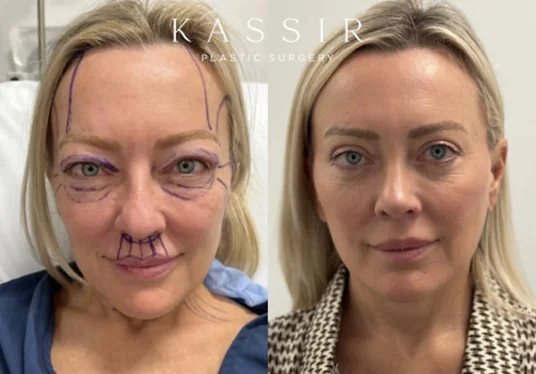
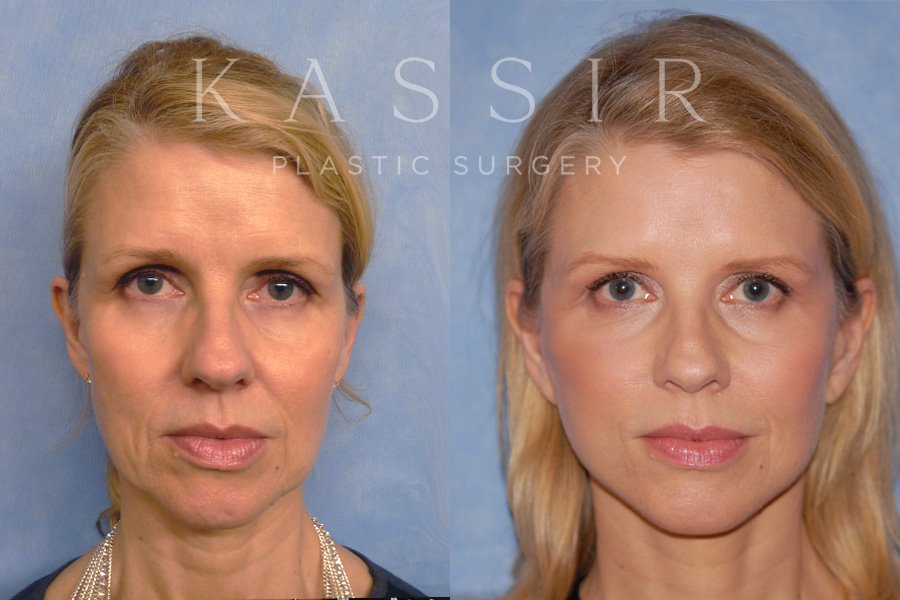
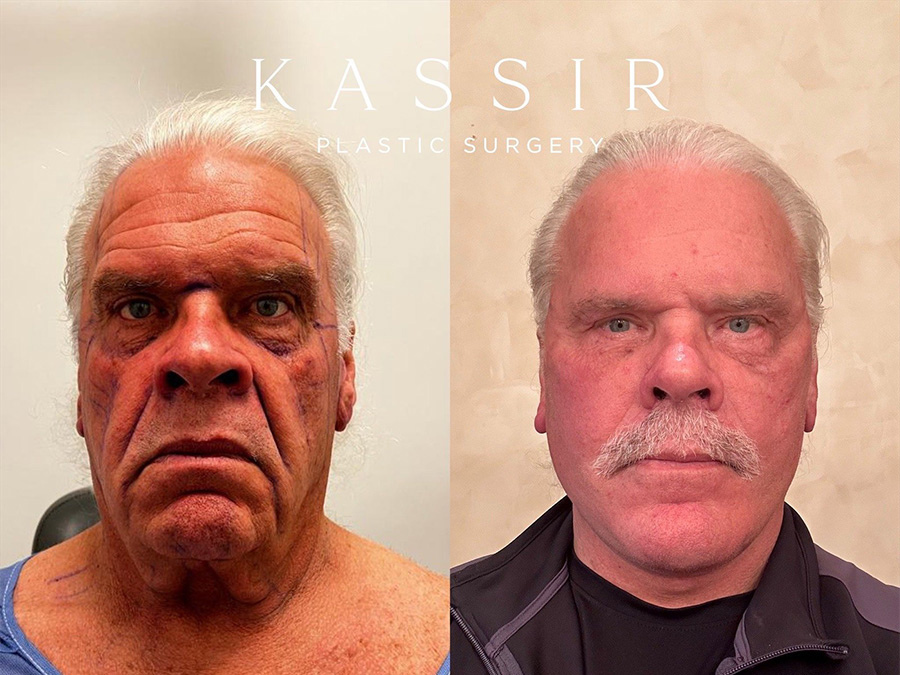
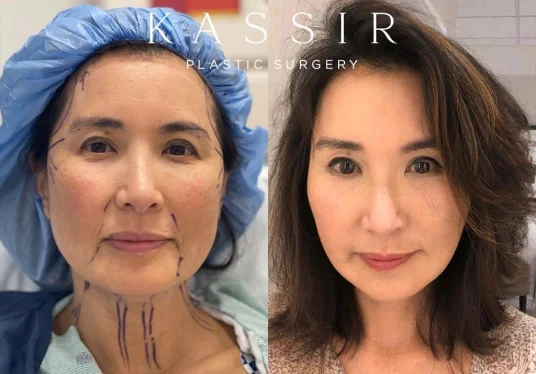
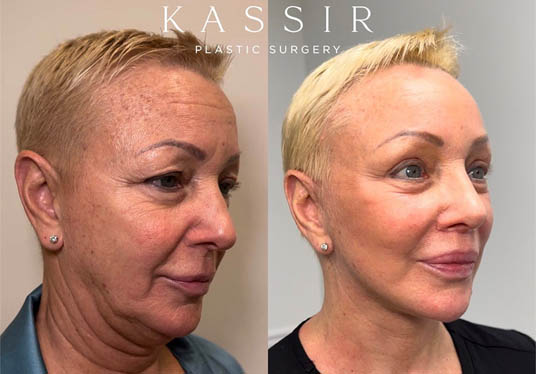
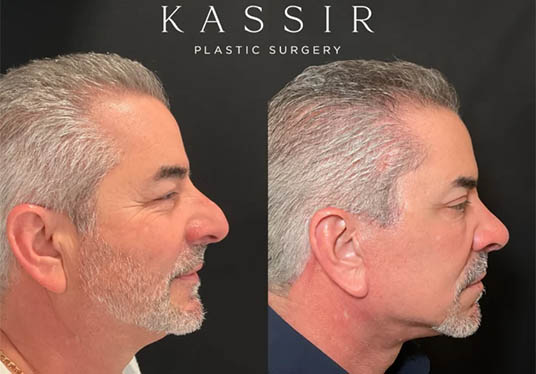
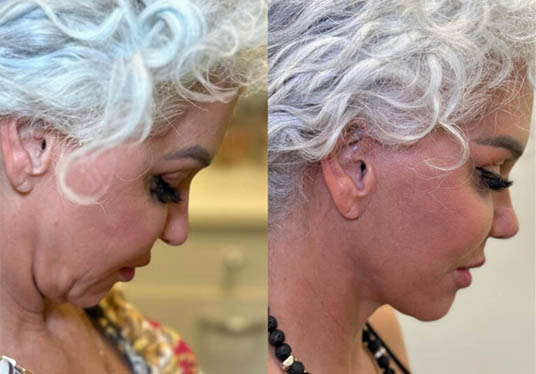
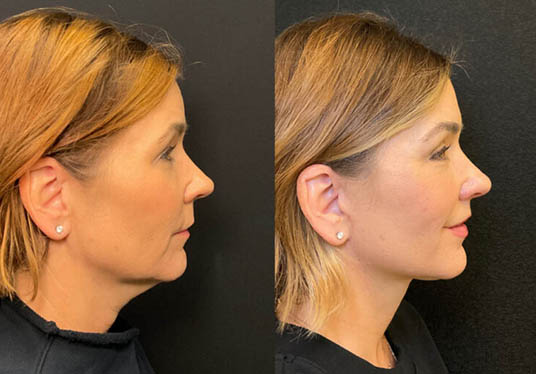
Facelift surgery can be performed in Dr. Kassir’s office or at an accredited surgical center. The patient is usually given a local anesthetic or sedative for the facelift procedure. An incision is made around the temple, along the hairline, and extends down to the earlobe. These facial incisions are carefully placed to minimize visible scarring. An additional incision is made under the chin to tighten the neck skin. The skin is then separated from the muscle and fat, and the fat may be trimmed or sucked out via liposuction.
Dr. Kassir then releases the SMAS (Superficial Musculoaponeurotic System) from its deep attachments in the deep plane. He then repositions it at a higher, more youthful level. This deep plane approach specifically targets and repositions the muscles responsible for facial expressions, resulting in more natural-looking, longer-lasting outcomes than surface-level techniques. Tightening and repositioning the SMAS in this manner gives the jawline a sleeker look and firms the neck. The skin is then pulled back over the incision site, and the excess skin is removed with a laser or a knife. The incision is then closed with stitches, sutures, or tissue glue. The stitches are placed within the hairline so they are hidden.
The surgery takes about 2 to 4 hours, depending on the extent of the muscle and tissue work. The incisions are hidden in the hairline and behind the ear. For some examples, see our recent blog post.
There are also other methods to achieve a younger-looking face that require less time to recover, such as the K-lift™ or liquid facelift with Restylane, Perlane, Belotero, Radiesse, Juvederm, Sculptra, Artefill, or fat.
Many other types of facelifts are favorable, including the mini-lift due to its short recovery time, the S-lift and the K-lift™, which focus on the lower part of the face (neck and chin), the mid-facelift, which includes small incisions in the hairline, above the ear, and inside the mouth, and the Tissue-glue facelift, which uses tissue glue to seal the incisions.
Some non-surgical techniques are also available at lower costs and with fewer risks. Thermage or Thermacool uses radio frequency to stimulate the body’s natural collagen, causing the skin to tighten and contract. This technique is best used for minor wrinkles; results can last 6 months to 2 years. Ultherapy uses sound waves to tighten the face and neck. Another alternative is the ThreadLift or FeatherLift, which involves inserting a needle with a surgical thread (or a non-absorbable suture) into the skin. The thread is then pulled tight, and the muscle and tissue tighten with it. This technique leaves no scars, and the thread remains in the body. Some risks of facelifts include infection, scarring, reaction to anesthesia, hematoma, damage to facial nerves, necrosis, and alopecia at the incision site. These risks are minimal, and the procedure results in a younger-looking you.